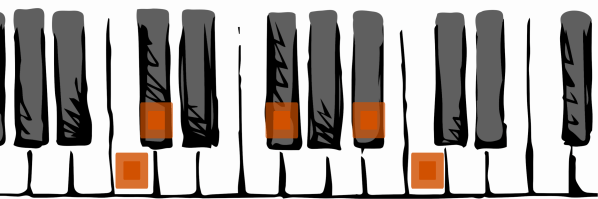
Before you read another word try playing this week’s scale-of-the-day through on your instrument:

Written on C it’s clear that this is the major scale with a single note adjusted a semitone higher.  It’s that it’s the 5th degree that has been adjusted that leads to the tonic chord having an augmented quality.

I’m not sure how I would go about composing with this scale, or how I would create a sense of genuine C tonality. Our western ears are attuned to the perfect 5th defining harmonic spaces, so this scale is challenging simply because that 5th degree does not create that expected consonance.

But even more challenging is the fact that the 5th is augmented. When we hear these two pitches out of context we assume (and believe deeply) that we are hearing a minor 6th, and we further project into this harmonic outline either a 2nd inversion of a minor chord or a 1st inversion of a major one.

It’s only when that additional note is positioned plumb between the bottom and top pitches that we hear the shape as expressing an augmented 5th (and an augmented chord). And when we hear that augmented quality, we rarely experience it as a point of conclusion or even pause; augmented-ness  suggests being on the way to somewhere else.

On the other hand, this scale presents us with some interesting relationships: the first and last 4 notes of the scale separate out into two contrasting contours. The first is simply the default position of the major scale, while the second is the shape we associate with the 7th, 1st, 2nd and 3rd notes of the melodic scale (that curly part of the pattern where two semitones get as close as they can to each other).

And the chords we can create with this scale are intense and wonderful.  Beyond moving between the I augmented and the IV major chords, and between the I augmented and the V diminished (an interesting exploration of how our diatonic expectations are stymied), we can create spectacular and fascinating complex chords. For example:

Where is this scale fun to play on the piano?  I like it a lot on E and B!

These are examples of what I call pseudo-symmetry: the pattern of white and black note is symmetrical, but the physical spacing is definitely not! But it’s a great-feeling scale in contrary motion because of that white/black pattern.

It’s also pseudo-symmetrical on F, but because the 4th and 5th degrees of the scale are black notes we end up having to play this scale with the thumbs on a note other than the tonic, and that feels very bewildering after a lifetime of diatonic white tonic scales. But the pseudo-symmetrical version on B flat is a delight (for the same reasons).

Finally, now we’ve explored all these positions of the scale, let’s acknowledge exactly what this scale is: the harmonic minor starting on the 3rd degree. In jazz parlance it’s known as Ionian #5, and if you’re up with your terminology that does actually express quite a lot (it’s a major scale with the 5th raised, therefore creating an augmented tonic).

But I’d love to get some feedback as to what this scale makes you feel, what this scale communicates. Scales that create a tonic with an augmented or diminished 5th are in a different category to those with that expected perfect 5th outline, and I’d love to come up with a name for these scales that don’t have the kind of tonic we are used to coming home to. Suggestions?

This week we’re looking at one of the modes of the major scale, and as all the modes of the major scale have a long tradition of being named in western music theory we won’t need to get worried about what it ‘ought’ to be called – that flag was planted long ago.

While the Phrygian mode and last week’s scale both have the 2nd and 7th flattened they end up sounding nothing alike, and that’s because the Phrygian mode has another two notes flattened (the 3rd and the 6th), while last week’s scale had one note raised (the 4th), with the result that three notes in the pattern are not shared.

The Phrygian mode is actually only one note different to the natural minor scale, but that flattened 2nd has such an unexpected aspect to it that we tend to hear it as vastly different from the familiar natural minor pattern.

Here is the Phrygian mode starting on C:

Notice how in this permutation the pattern is symmetrical – white-black-black-white-white-black-black-white.  This makes it a joy to play in contrary motion, and is one of my contrary favourites, without a doubt.

There are two super-easy ways of finding this mode.  The first is to simply play all the white notes from E to E.  The other is to play F and C and then add all the black notes.  (I find this second method more fun).

I used this Phrygian on F in my Grade 1 standard piano piece Milli-Molli-Mandi-pede from the Faber/Trinity publication Creepy Crawlies (also available in Australia in the Hal Leonard publication Getting to Grade One New Mix). Here’s how that piece starts:

This ends up sounding reasonably ‘normal’ because the theme is so focussed on the F and the C, the same perfect 5th you would expect to hear in a major, melodic minor or harmonic minor scale.  So the Phrygian marker note (the flattened 2nd) doesn’t stand out so much as it is rapidly passed through as the melody moves between the dominant and tonic notes.

But try playing through the triads of the Phrygian mode.  The pattern goes like this:

i II III iv v° VI vii

minor-Major-Major-minor-diminished-Major-minor

Or, in notation, on C:

This combination creates a quite positive spin on the extremely minor pattern, as the minor key chord rises to two Major chords. And while in a major mode the chord a 3rd above and a 3rd below the key note are minor, in the Phrygian mode the situation is reversed, creating a background harmonic context of contentedness, even if the key chord is melancholic. On the other hand, the semitone distance between the tonic and the 2nd note of the scale creates a high degree of tension (maybe it’s just heightened alertness, or then maybe it’s just a kind of unease) which works against the contented vibe major chords normally communicate.

I described the flattened 2nd as imparting a sensual atmosphere to last week’s scale, but here that impact is mitigated by the 3rd also being flattened – or maybe it’s just that the flattened 2nd sensuality feels more everyday without the augmented 2nd interval following.

How do you respond to the Phrygian mode?  Does it have any predictable emotional connotations to you?  And do you have any favourite pieces of music in this most interesting of tonic-minor modes?

Anita Milne is my mother

January 24, 2010

It’s time to write a piece about my mum.  Mums are self-evidently worth writing about, but in my case I am further motivated to do so knowing that about 10 people have discovered my blog in the past seven days because they were wanting to know more about my mum, Anita.

A brief history: Anita was born in Christchurch, New Zealand in 1943 and started piano lessons at the age of nine. She progressed rapidly, and was teaching the piano herself by the time she was in her late teens, as well as working as an accompanist and organist. She married Richard Milne (born in Prosperpine, QLD, and working in Christchurch at the time) in 1963.

I was born when Anita was nearly 24 and living in Wahroonga, Sydney, and I grew up listening to her piano lessons (as a baby) and hearing her students practice (as I became older).  When she was 27 our whole family moved to the Manawatu district of New Zealand where Richard was the Business Manager of a boarding college, Longburn College.  While there Anita was asked to join the faculty teaching high school music, as well as being the resident piano, organ and theory teacher.

During the nearly 10 years we were at Longburn Anita also organised a series of concerts performed by the students, which subsequently toured New Zealand.  Anita also organised children’s singing groups and produced and directed music theatre presentations by children and adolescents.  And it was during this time that Anita gained a number of piano teaching qualifications (LTCL and LRSM), as well as taking further training as an organist.

In 1980 we moved to Auckland, and Anita established a piano teaching practice there (in the St Heliers/Glendowie area), until 1985 when Richard was headhunted for a job in Sydney.  Anita moved to Sydney in the second half of 1985, and Richard and Anita built a home in Cherrybrook which then was the site of her piano teaching practice until the middle of last year (2009).

During the most of the more than 20 years Anita was teaching in Cherrybrook I also worked as a piano teacher alongside her (from 1989), and my sister, Suzanne, also taught piano with us for a number of years.  The house really did become devoted to piano teaching, and during the time all three of us were working together we devised a number of programs and teaching aids that made the experience of learning piano at our studio quite unique. The studio was originally called the Milne Music Studio, later changing to Pepperbox School of Music.

And it was during this time that Anita started urging me to compose educational piano music (which I first started doing in November 1995).  And over the next few years Anita was an integral part of my composing process, giving me feedback from a piano teacher’s point of view as to the usefulness of each of my compositions, and the likelihood (in her opinion) that students would actually want to play the pieces.

In 2001 I started collating the material that would become the Getting to series (Preliminary, Grades One and Two first published in 2003), and it was during this period that Anita started notating the ideas that she had been teaching with over the years.  In 2006 I included one of these pieces in each of Getting to Preliminary, The New Mix and Getting to Grade One, The New Mix.

In 2006 we were also working on a publication that Faber Music were going to publish, My Very First Little Peppers, pieces mostly composed by Anita for use with students in the first six months of lessons. My pregnancy in 2006 interrupted the timeframes of this publication, and to date Faber Music have not published the collection, but two of the pieces Anita had composed during this period have been included in last year’s P Plate Piano publications from the Australia Music Examination Board.

Anita’s published music to date:

The Last Leaves of Autumn, in P Plate Piano Book One. This piece is a beautiful piece exploring how to play the two-note slur, and also exploring how harmonics work on the piano.  Students cover the whole keyboard while playing this piece.

Who’s There, in P Plate Piano Book Two. This piece is partly off-keyboard, with students knocking rhythms on the body of the piano alternating with 5ths being played in either hand.  This piece also explores the difference between a perfect and a diminished 5th, and explores the idea of enharmonic equivalence, with the right hand playing G flat, while the left hand plays F sharp.

Shiver Me Timbers, in Getting to Preliminary, the New Mix. This piece is really a set of variations on the chords A minor and G major, in much the same way that the folk song “What shall we do with the drunken sailor” is.  All sorts of pianistic possibilities are explored, including clusters, triads and moving between octaves, as well as a range of articulations and rhythmic devices.

Shiver Me Timbers II, in Getting to Grade One, the New Mix. This piece is a more difficult set of variations on the same harmonic sequence as Shiver Me Timbers.

Anita doesn’t really consider herself a composer, simply a piano teacher coming up with material that solves the problems she sees her students facing as they attempt to master various techniques and styles.  But her material is really well written and the students enjoy playing her music.  It’s not the kind of old-fashioned stuff one normally assumes piano teachers will come up with – but maybe in the 21st century we expect different things from piano teachers than we did in the 20th.

I rely on Anita to give me brutally honest feedback about my compositions and ideas, and we teach each other’s students from time to time to monitor how different students respond to different approaches.  And of course, I’ve benefitted from her experience as a piano teacher right from my earliest years: Anita was an early adopter of new music that would become available in New Zealand, and I think she was among the first teachers there to really use the music of Kabalevksy and Rybicki there in the 1970s.  Her interest in finding engaging new repertoire resulted in my hearing a wide range of piano music as a child and student, and certainly impacted on my own ideas about what makes a good piece of educational piano music.

Hopefully we’ll get that My Very First Little Peppers book published soon!  But in the meantime I’m sure there will be other publications in which Anita’s music will surface.

Anita and Richard moved to Annandale (in Sydney’s inner west) in the middle of 2009, and Anita is now teaching some students at her new home while still teaching her remaining students in Sydney’s north-west from a piano teaching venue in a primary school in that area. Anita and I are currently working on a range of new ideas for working with students in the first five years of lessons, and are road-testing these concepts on Anita’s students this year, with a view to making them more widely available in 2011.

If there’s anything you were hoping to find out that I may have omitted, please just leave a comment below and I’ll attempt to provide you with any and all salient details that are of interest!

When asking if I am really an Australian composer, and if it mattered all that much anyway, I was asking for trouble.  Especially in the week preceding Australia Day.

Comments posted to my Facebook page convinced me that when I questioned the value of national identity I did so in a myopia of macro-thinking (thinking “do I represent this nation?”), and was forgetting all about the micro-realities about identity (“do I live in my community?”).

Of course it matters if I am Australian to the children from Australia who play my music: me being from where they are from tells them that composers live in their community, which is a double shock to some people (the fact that composers are alive at all, and that they live down the road).  It matters to the Kiwi kids who find out I grew up half an hour away from where they live, or I went to school at their high school.

Knowing that someone just like you (who lives in your street, who went to your school) has grown up to be a composer tells children that this is a perfectly legitimate career choice for them to make, and that real music (published and all) is composed in the very community they are living in.

This can be a transformational realisation, especially in a world (classical music) where so many of the heroes are from a foreign country and well dead.  I don’t know what it’s like to grow up as a piano student in Germany, but it has to be an entirely different sensation, knowing that the Beethoven sonata you are learning was composed in a house only a short trip down the road, or that the Bach Prelude and Fugue you are practicing was first performed in the neighbouring town.  It simply has to change the way you set about the task, playing something indigenous, something local.

Then there’s the other aspect to my ambivalence about claiming to be an Australian composer: what does that even mean?  Well, Prince William’s speech writers summed it up for me on Thursday when they said that Australians are notable for their vibrancy, their straight forward ways and their classic sense of humour.  I caught a sound-bite of Prince William (participating in the state of Victoria’s Australia Day celebrations) listing off these admirable Australian attributes, and I realised that, on the basis of these qualities, I am entirely and deeply Australian, and my music is even more so.

What a relief.

Scale of the Day #3

January 21, 2010

This scale, starting on D as shown above, is my favourite scale of all time. It feels unbelievably wonderful under the hand – three black notes in a row, four white notes in a row. And as good as it is to play in similar motion hands an octave apart, just wait til you try it thirds or sixths apart (magic), or contrary motion (strange and wonderful).

What makes this my favourite? Well, it has all my favourite features: the raised 4th of the Lydian mode which communicates curiosity and optimism; the flattened 7th of the Mixolydian mode which communicates a lack of tension and a trusting approach to life; and then to top it off we have the flattened 2nd which imbues any scale with exoticism and sensuality.

How could anyone not like this scale?

If you’ve been following the scale of the day you will notice that this is almost the same as last week’s Simpsons Scale  - the only change is that flattened 2nd.  But this one change means that the pattern is no longer from the pitch class of major modes, or of melodic ascending modes, and it doesn’t belong to the harmonic minor pattern either. This scale is one of the modes of the pattern I call the melodic diminished. Keeping the same notes we have in the scale shown at the start of this post, let’s just start on a different note:

You can quickly see that this is the melodic ascending pattern, only the 5th note (E) has been flattened, which creates a diminished tonic chord, hence my naming of this pattern ‘melodic diminished’.

So one option for giving a name to my favourite scale of all time is to call it “Melodic Diminished on the 4th degree”, but this approach to labelling is forensic rather than evocative, creating little incentive for the newcomer to make the acquaintance of this scale.

Naming is a powerful thing.  When we know the name of something, our ability to know the thing itself is transformed. Naming is about classifying a thing, making a judgement as to how it works and what it does.  So choosing to give an obtuse and derivative title to a scale implies that the scale’s meanings are equally obtuse and derivative.

So, what should we call this pattern? And what names has it been given in traditions outside of classical Western music theory?

Do you know any pieces of music that feature this pattern? And do you enjoy the sound and the feel of this pattern as much as I do?!

It has often struck me that describing myself as an Australian composer is not an overly enlightening statement.

Sure, I was born in Sydney (specifically, in Wahroonga, at the San, on Fox Valley Road), spent the first three and three quarter years of my life living there, and have now lived in Sydney for the 21 years since I was 21. My passport is Australian. I even have a kind of Australian accent these days.

But my formative years were spent in New Zealand, and it was there that I undertook the bulk of my musical education, and it is the sounds of New Zealand that shaped the way I hear the world.  That and my parents’ record collection, and various films and programs broadcast by Television New Zealand in the 1970s.

Maybe even more importantly, once we moved to New Zealand we lived on the campus of a boarding college which had a strong religious component to the on-campus experience: hymns, religious music from the Baroque to the then current day, choirs, organ music, guitars accompanying camp fire singalongs, spontaneous a capella singing, men’s quartets, women’s trios, solo vocalists, you name it – if it had a function in a local community church it was part of my experience.

And experiencing this kind of religious music at a boarding college in New Zealand had the added element that I was making music with gifted young musicians from Tonga, Samoa, Fiji, the Cook Islands, Norfolk and Pitcairn Islands, even sometimes from Tahiti. And that’s without taking into account the New Zealanders who were not of immigrant descent, the Maori students. It was a quite Polynesian musical upbringing, for a kid whose ancestry is fundamentally Scottish.

So.  What does it mean to describe myself as an Australian composer?

Well, geography, I suppose – I live here.  And maybe in addition I do fit into a narrative of larrikinism. And the third thing is that I have certainly made an effort to create titles for my educational piano music (and the handful of educational pieces I’ve written for other instruments) which connect the story of the music to the real lives of Australian children.  So I have pieces in my Little Peppers and Pepperbox Jazz series called: Cockatoo, Mozzie, The Lone Echidna, Bandicoot Ballet, Brolga Stroll, No Worries, Larrikin, Wombat, and Mulga Bill.

But more importantly, in my opinion, is that my tempo indications are in English, and evoke rather than dictate a performance approach: Glistening, Alarming, Laid-back, Nimble, Buzzing, Frantic, Showing Off, Feeling better than usual, and so on. Now this isn’t an effort to be democratic (a most American notion), but reflects being part of a culture in which authority figures are figures of fun, where expecting others to do as you say only sets you up for ridicule.  These are tempo descriptions, not tempo demands – I know, as an Australian, that you’ll end up doing whatever you want in any case! But should you be interested these tempo markings give you a clue as to what I reckon.

Pomposity is a capital offense in Australia.

Which leads to another element of my composing that maybe does mark me as an Australian. Brevity.  There’s not a lot of waffle or filler in my compositions.  I say what I feel needs to be said, and then move on.  Other cultures do seem to beat around the bush when addressing a point, but that’s not really culturally comprehensible in Australia (or New Zealand, for that matter). Our current prime minister speaks in bureaucratese at times, and is mocked and pilloried whenever an example of this tendency surfaces. But since he takes the mickey out himself (to a certain extent, in public anyway) he doesn’t suffer in the opinion polls.  [You can be any kind of person in Australia and be completely accepted so long as you don't take yourself too seriously and you don't think you deserve special treatment.] But I suspect that exactly the same kind of hyper-diplomatic or extreme-management use of language by a prime minister would not even raise an eyebrow in other countries.

Well, that’s as it may be, but am I really an ‘Australian’ composer because I live in Australia, sometimes name my pieces after Australian fauna, expect performers to do what they want with my music, and, write music that doesn’t mince measures?

Seems so.  And it also seems to me, in this age of instant everywhere, that my nationality is mostly important in terms of what this allows me to do and disallows me from doing. In theory Australian educators will be more likely to want to teach music by Australian composers, and there are, theoretically, funds available to support Australian music-making and composition – defined pretty much by one’s passport and address.

So yes, I’m an Australian composer.  Does this admission mean anything much to anyone? I’m suspecting not.

But maybe I’m being myopic, some kind of mid-summer response to the enthusiasm for flag-waving that might engulf us on Australia Day (January 26).  I’d be fascinated to know what you think – does being an Australian composer actually mean anything in 2010?

Rather than alter the original post (which would make the comments below somewhat hard to follow) I will leave it as is, but point out that “The Simpsons Scale” certainly does have a name within the jazz tradition, the Lydian-Dominant (just as last week’s scale has a name within the tradition of South Indian classical music, “Mayamalavagowla”), so in reality when I call this scale “The Simpsons Scale” I am boldly naming what hundreds of thousands in the world of jazz have named before. (And note that this scale has a name in the South Indian tradition  [Mouli's comments below]).

Now this scale isn’t actually called “The Simpsons Scale”, but since it isn’t actually called anything [in western theory] I have decided to boldly name what no one has named before.

In reality the Simpsons scale is the melodic ascending pattern starting on the 4th degree, but it happens to be the pitch pattern used for the tonic harmonies in the theme music to The Simpsons, so I decree that the scale henceforth be known as…..

Here’s the pattern, in F (because the pattern of white/black notes is identical to that of G Major):And here in C (so it is easy to see at a glance which notes have been altered, and by how much, from a ‘neutral’ major pattern):

And here is how the theme from the Simpsons goes (in seriously truncated form, so that all the notes of the pattern as evident):

This sounds like the Lydian mode, to a casual listener, because the raised 4th is the predominant note in the melodic sequence, while the Mixolydian marker, the flattened 7th, only makes an appearance as the theme wraps up at the every end .  But a careful listener will notice that this is the only kind of 7th note that occurs in the harmony also.

Yes, this pattern has the Lydian and the Mixolydian marker notes, so it’s a kind of Hyperlydian, succeeding in doing both the fundamentally major modes at once.  It’s a sensationally modern take on major, sounding quirky but smart, and full of a very contemporary energy.

I used this “Simpsons Scale” as the basis for my trumpet composition, Go-Goanna, published by Faber Music in their Fingerprints series, and now an ABRSM exam piece (Grade 4). But while Danny Elfman creates the feeling that we are flickering between C Major and D Major, in Go-Goanna the melody is shaped so that it feels like an alternation between C Major and G minor (in transposition), with the G minor leading note (F sharp) as part of the equation.  It’s interesting to me that this same scale produces two equally successful harmonic partnerships from its triads.

It takes a while to become accustomed to playing this scale, obviously to the ear, which is expecting neither the raised 4th or flattened 7th, but more especially to the fingers, who simply refuse to believe that a major-sounding pattern has its two semitones positioned so close to one another.  This is why I included the scale pattern in F – one’s fingers can be tricked into playing this correctly quite swiftly if one focuses on playing that G Major pattern that we know so well, but hearing this brand new pattern! As it turns out, starting on G is a similar proposition: play the white/black note pattern of F Major and you’ll get it first try.  Starting on F sharp can be quite rewarding also, as one can concentrate on playing the C (really B sharp) and the E around the two black note group.

Have a play, and then have your say.  How do you like it, and what does it make you feel?  And is this name, The Simpsons Scale, really the right one??!

Here is the first scale-of-the-day, and this is a pattern I heard used in a composition by Australian oud player, Joseph Tawadros, when he performed recently at Government House in Sydney.  It was an original composition of his, and he told me that it used a traditional Egyptian mode.

Well, of course, this pattern has nothing Western about it, with those two augmented seconds, and subsequent consecutive semitones.

Play through the triads based on the first four notes of the scale: you get C Major, D flat major, E minor and F minor. But just where you would expect to find a dominant chord if you were listening with Western ears, there is a complete absence of anything that resembles the harmonic function fulfilled by a dominant chord.  That D flat turns it into a chord without any dominance at all.

The way Joseph used the mode was fabulous: the harmonic centres seesawed from the major-inflected tonic to the assuredly minor subdominant, and much time in the tonic position was spent spinning around on the axis the tonic provides to the upper and lower semitones (D flat and B). Highly energising.

As I frequently find to be the case with the patterns I enjoy the sound of, this is a physical delight to play on D, in this instance because of its perfect symmetry:

And I noticed this pattern in Joseph Tawadros’ composition because I’ve used this same pattern (but on the 4th degree) in music I composed for the recently released P Plate Piano series I did with the Australian Music Examination Board.  My piece was called Sad Farmer, it’s in P Plate Piano Book One (so ©AMEB) and it starts like this:

[Needless to say, in P Plate Piano we don't explain anything about the theory of the scale, but students are encouraged to experiment with different black notes until they can make a happy farmer!]

I have no idea what this pattern is called in traditional Egyptian music theory, or if this pattern exists in a myriad of other musical cultures (I’m sure it does). But in terms of our western ears those two augmented seconds create the impression of a surfeit of exoticism.  Remember how exciting a harmonic minor scale sounded the first time you learned how to play it?  This scale doubles the frisson, magnifies the sensation of participating in something quite wonderful and utterly other.

So what to name it, from a western listener’s perspective?  The term “Double Harmonic”, I think, would be easily understood on first listening, but does the word “Harmonic” really have an equivalence with the inclusion of the augmented 2nd?

Meantime, there are other patterns one can make with two augmented seconds in a 7 note scale, so maybe using a generic term such as “Double Harmonic” should be restricted to the class, not the species?

So what do you think?  How does it sound when you play it? And how does it feel? Have you tried it contrary motion on D??!!  And what would you suggest we think about calling it?

2010 has dawned with a lot of people I know participating in a project to photograph some aspect of every day in the year – a lovely discipline to find things of visual and conversational interest in even the mundane moments life brings, I suspect.  I’ve been really enjoying the photographs posted in various networking media.

But it led me to thinking: how about, instead of a visual image, a scale of the day?

No, not the major and harmonic minor ones we’ve all practiced frantically in the final two weeks before our instrumental examinations.  Last year my most popular post, by some long way, was one I entitled Scales as Propaganda, where I argued that the patterns we learn to play are also the patterns we learn to hear, and the music of our lifetimes is replete with patterns that our [Western] culture,historically, doesn’t believe we should be recognising (otherwise we wouldn’t be able to pass our Grade 8 exams without playing some of them).

I’m proposing that the Scale of the Day  look at the other scales, the modes, the patterns we don’t have names for that are used by composers working today as they create fascinating tonal music people are drawn to listen to.

I put a quick message up on facebook to see who might be interested, and it looks as if we already have a quorum for the 2010 Scale of the Day (on a weekly basis) Experience.

The idea is that each week I will write up a piece about a different, probably unnamed, scale pattern, and then we’ll all go away and play with that pattern and report back as to how we liked it, how it made us feel, how challenging it was to master physically/aurally, all that kind of thing, and see where it leads.

So who’s in?!

Choosing Repertoire

January 4, 2010

I’m preoccupied this week with thoughts revolving around how we choose repertoire for our students.  I’d like to be able to say with rather than for our students, but most of the time the student gets at best a veto (not quite the same thing as being actively part of the process).

This topic was one I spoke on at the 2009 Australian Piano Pedagogy Conference held in Sydney in July, and at that time I titled my presentation Repertoire Roulette, attempting to draw attention to the hit and miss nature of a piano student’s repertoire selection, the element of risking something valuable (the attention and long-term interest of the student) if we should happen to stake our lesson time on a piece of repertoire that doesn’t come up a winner.

If only the pieces of piano music we use in our teaching came with guarantees. Or at least a warranty.

So here’s the thing that comes first, something which I think is so obvious it really doesn’t need to be said, but it turns out we are living in the real world, so here goes:

  • Does the student know how to ‘do’ the piece?  Have they mastered the technical skills required to perform the music?

The way many piano students have been taught this question has not really come into consideration. The repertoire is used as a vehicle for gaining a skill, not an opportunity for demonstrating a skill already attained.  Which means that students practice one hand at a time, 1, 2 or 4 bars at a time, taking weeks and weeks to learn the notes of the piece before they ever start to hear the music when they play.  And there will probably always be one section in the music that the student never really quite manages to perform perfectly.

To teach repertoire only once the requisite skills have been acquired means that teachers need to be aware of all the technical challenges a new piece of repertoire brings with it, and to have teaching strategies – in advance – for meeting those challenges.

I’ve been launching these three P Plate Piano books around Australia that I’ve compiled and edited for the Australian Music Examination Board, and there are quite a few pieces in the three volumes where I would find myself suggesting “teach the gesture first”.  For example, there is a piece I’ve composed for the first volume called Where’s Goldilocks?, which is almost entirely composed of sets of two staccato notes played on the same pitch.  Any experienced teacher of beginners knows that students will play the first staccato note with a beautiful crisp and detached articulation, but the second note will be played with a resigned tenuto touch (at best) despite repeated exhortations to bounce off, to lift swiftly, to play the note as if it were hot, or any other visual or verbal imagery that the teacher can conjure off the cuff in response to this lame effort.

Rather than waiting for the student to get it wrong, I suggest teaching the gesture first, in this case asking the student to knock twice with their knuckles on the piano lid as if they were knocking on a door.  This creates the two staccato note effect we will be looking to produce in the piece we are about to learn (Where’s Goldilocks?).  Once the student has demonstrated a mastery of knocking ’staccato’, reduce the gesture to the fingertips (knock, knock), just two fingertips (knock, knock), and then just one single fingertip knocking out the two staccato notes we are seeking to perform throughout the piece.

Now we open the score of the print music and start exploring the notes, with the gestural content of the repertoire already well and truly a part of the student’s muscle memory and performance expectation.

All well and good.

But if as teachers we are not already conscious of the technical challenge students find with the repeated staccato notes we will not be prepared to guide our students into a mastery of the performance of the repertoire.  We will simply be onlookers as our students fumble their way through a new bit of sight reading, with our role restricted to correcting faulty readings.

This same principle holds true even in regard to quite advanced repertoire.  Firstly, do we know what the technical challenges of a new piece of repertoire actually are [in toto, as well as in regard to this specific student]? Then, does the student already have a familiarity with these skills? And finally, if the students does not [have a familiarity with these skills], are we ready to guide them in a manner that is enjoyable, efficacious and efficient, leading from the joy of learning how to do something new into the equal joy of learning new music.

It sounds so obvious, I know, and yet I also know we find ourselves, for a variety of reasons, teaching our students music that asks more than they can manage, and then we wonder what we did wrong when the student wants to abandon the selection before they are really able to perform it properly.  True performance happiness comes from putting the skills you have acquired to the task of playing music that you love.

Which is a clue to the second principle of choosing repertoire, but that’s for another post, another day.